05Metadata
Metadata
package priv.king.resource;

import org.springframework.beans.factory.annotation.Autowired;
import org.springframework.scheduling.annotation.EnableAsync;
import org.springframework.stereotype.Service;

import java.io.Serializable;
import java.util.HashMap;

/**
 * @author king
 * TIME: 2020/4/11 - 19:19
 **/
// 准备一个Class类 作为Demo演示
@Service("serviceName")
@EnableAsync
class Temp extends HashMap<String, String> implements Serializable {
	private static class InnerClass {
	}

	@Autowired
	private String getName() {
		return "demo";
	}
}
/**
 * @author king
 * TIME: 2020/4/11 - 19:20
 **/
public class Main {
	public static void main(String[] args) {
		//基于反射获取信息
		StandardAnnotationMetadata metadata = new StandardAnnotationMetadata(Temp.class, true);

		// 演示ClassMetadata的效果
		System.out.println("==============ClassMetadata==============");
		ClassMetadata classMetadata = metadata;
		System.out.println(classMetadata.getClassName()); //priv.king.resource.Temp
		System.out.println(classMetadata.getEnclosingClassName()); //null  如果自己是内部类此处就有值了
		System.out.println(StringUtils.arrayToCommaDelimitedString(classMetadata.getMemberClassNames())); //priv.king.resource.Temp$InnerClass 若木有内部类返回空数组[]
		System.out.println(StringUtils.arrayToCommaDelimitedString(classMetadata.getInterfaceNames())); // java.io.Serializable
		System.out.println(classMetadata.hasSuperClass()); // true(只有Object这里是false)
		System.out.println(classMetadata.getSuperClassName()); // java.util.HashMap

		System.out.println(classMetadata.isAnnotation()); // false(是否是注解类型的Class,这里显然是false)
		System.out.println(classMetadata.isFinal()); // false
		System.out.println(classMetadata.isIndependent()); // true(top class或者static inner class,就是独立可new的)
		// 演示AnnotatedTypeMetadata的效果
		System.out.println("==============AnnotatedTypeMetadata==============");
		AnnotatedTypeMetadata annotatedTypeMetadata = metadata;
		//最终调用Test.class.getDeclaredAnnotations()
		System.out.println(annotatedTypeMetadata.isAnnotated(Service.class.getName())); // true(依赖的AnnotatedElementUtils.isAnnotated这个方法)
		System.out.println(annotatedTypeMetadata.isAnnotated(Component.class.getName())); // true

		System.out.println(annotatedTypeMetadata.getAnnotationAttributes(Service.class.getName())); //{value=serviceName}
		System.out.println(annotatedTypeMetadata.getAnnotationAttributes(Component.class.getName())); // {value=repositoryName}(@Repository的value值覆盖了@Service的)
		System.out.println(annotatedTypeMetadata.getAnnotationAttributes(EnableAsync.class.getName())); // {order=2147483647, annotation=interface java.lang.annotation.Annotation, proxyTargetClass=false, mode=PROXY}

		// 看看getAll的区别:value都是数组的形式
		System.out.println(annotatedTypeMetadata.getAllAnnotationAttributes(Service.class.getName())); // {value=[serviceName]}
		System.out.println(annotatedTypeMetadata.getAllAnnotationAttributes(Component.class.getName())); // {value=[, ]} --> 两个Component的value值都拿到了,只是都是空串而已
		System.out.println(annotatedTypeMetadata.getAllAnnotationAttributes(EnableAsync.class.getName())); //{order=[2147483647], annotation=[interface java.lang.annotation.Annotation], proxyTargetClass=[false], mode=[PROXY]}

		// 演示子接口AnnotationMetadata 对Method有支持,同时继承ClassMetadata, AnnotatedTypeMetadata
		System.out.println("==============AnnotationMetadata==============");
		AnnotationMetadata annotationMetadata = metadata;
		System.out.println(annotationMetadata.getAnnotationTypes()); // [org.springframework.stereotype.Repository, org.springframework.stereotype.Service, org.springframework.scheduling.annotation.EnableAsync]
		System.out.println(annotationMetadata.getMetaAnnotationTypes(Service.class.getName())); // [org.springframework.stereotype.Component, org.springframework.stereotype.Indexed]
		System.out.println(annotationMetadata.getMetaAnnotationTypes(Component.class.getName())); // [](meta就是获取注解上面的注解,会排除掉java.lang这些注解们)

		System.out.println(annotationMetadata.hasAnnotation(Service.class.getName())); // true 直接注解
		System.out.println(annotationMetadata.hasAnnotation(Component.class.getName())); // false(注意这里返回的是false)

		System.out.println(annotationMetadata.hasMetaAnnotation(Service.class.getName())); // false(元注解)
		System.out.println(annotationMetadata.hasMetaAnnotation(Component.class.getName())); // true

		System.out.println(annotationMetadata.hasAnnotatedMethods(Autowired.class.getName())); // true
		annotationMetadata.getAnnotatedMethods(Autowired.class.getName()).forEach(methodMetadata -> {
			System.out.println(methodMetadata.getClass()); // class org.springframework.core.type.StandardMethodMetadata
			System.out.println(methodMetadata.getMethodName()); // getName
			System.out.println(methodMetadata.getReturnTypeName()); // java.lang.String
		});
	}

}
/**
 * @author king
 * TIME: 2020/4/11 - 23:12
 **/
public class Main2 {
	public static void main(String[] args) throws IOException {
		CachingMetadataReaderFactory readerFactory = new CachingMetadataReaderFactory();
		// 下面两种初始化方式都可,效果一样
		MetadataReader metadataReader = readerFactory.getMetadataReader(Temp.class.getName());
		//MetadataReader metadataReader = readerFactory.getMetadataReader(new ClassPathResource("java/priv/king/resource/Temp.class"));

		ClassMetadata classMetadata = metadataReader.getClassMetadata();
		AnnotationMetadata annotationMetadata = metadataReader.getAnnotationMetadata();
		Resource resource = metadataReader.getResource();

		System.out.println(classMetadata); // org.springframework.core.type.classreading.SimpleAnnotationMetadata@41906a77
		System.out.println(annotationMetadata); // org.springframework.core.type.classreading.SimpleAnnotationMetadata@41906a77
		System.out.println(resource); // class path resource [priv/king/resource/Temp.class]

	}
}
总结
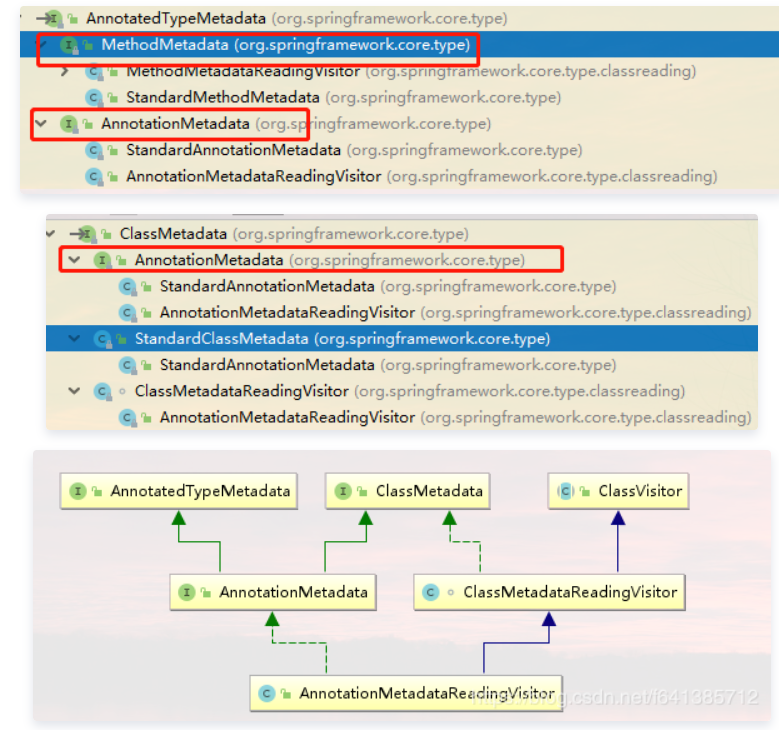
- 不管是ClassMetadata还是AnnotatedTypeMetadata都会有基于反射和基于ASM的两种解决方案,他们能使用于不同的场景:
- 标准反射:它依赖于Class,优点是实现简单,缺点是使用时必须把Class加载进来。
- ASM:无需提前加载Class入JVM,所有特别特别适用于形如Spring应用扫描的场景(扫描所有资源,但并不是加载所有进JVM/容器~)
05Metadata
https://jiajun.xyz/2020/10/10/java/spring/05Metadata/