01组件
本文最后更新于 2022-05-26 11:25:30
组件
EventLoop
事件循环对象 eventloop
eventloop本质是一个单线程执行器
它的继承关系如下
- 继承自 j.u.c.ScheduledExecutorService 因此包含了线程池中所有的方法
- 继承自 netty 自己的 OrderedEventExecutor
- 提供了 boolean inEventLoop(Thread thread) 方法判断一个线程是否属于此 EventLoop
- 提供了 EventLoopGroup parent() 方法来看看自己属于哪个 EventLoopGroup
实现循环组 eventloopgroup
EventLoopGroup 是一组 EventLoop,Channel 一般会调用 EventLoopGroup 的 register 方法来绑定其中一个 EventLoop,后续这个 Channel 上的 io 事件都由此 EventLoop 来处理(保证了 io 事件处理时的线程安全)
- 继承自 netty 自己的 EventExecutorGroup最终还是继承自ScheduledExecutorService
- 实现了 Iterable 接口提供遍历 EventLoop 的能力
- 另有 next 方法获取集合中下一个 EventLoop
处理普通以及定时任务
就是ScheduledExecutorService
EventLoopGroup group = new NioEventLoopGroup(2);

/*io.netty.channel.nio.NioEventLoop@4fca772d
io.netty.channel.nio.NioEventLoop@9807454
io.netty.channel.nio.NioEventLoop@4fca772d
io.netty.channel.nio.NioEventLoop@9807454*/
System.out.println(group.next());
System.out.println(group.next());
System.out.println(group.next());
System.out.println(group.next());

group.next().submit(()->{
    try {
        Thread.sleep(1000L);
    } catch (InterruptedException e) {
        e.printStackTrace();
    }
    System.out.println("submit thread");
});

System.out.println("main thread");
处理IO任务
同一个pipeline上的handler在同一个group
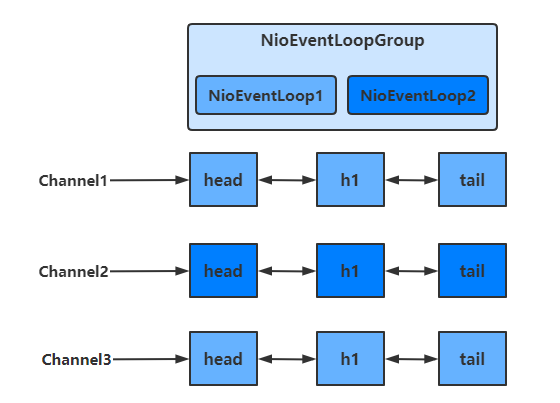
server
public class MyServer {
    public static void main(String[] args) {
        new ServerBootstrap()
                .group(new NioEventLoopGroup())
                .channel(NioServerSocketChannel.class)
                .childHandler(new ChannelInitializer<SocketChannel>() {
                    @Override
                    protected void initChannel(SocketChannel socketChannel) throws Exception {
                        socketChannel.pipeline().addLast(new ChannelInboundHandlerAdapter() {
                            @Override
                            public void channelRead(ChannelHandlerContext ctx, Object msg) throws Exception {
                                ByteBuf buf = (ByteBuf) msg;
                                System.out.println(Thread.currentThread().getName() + " " + buf.toString(StandardCharsets.UTF_8));

                            }
                        });
                    }
                })
                .bind(8080);
    }
}
client
public class MyClient {
    public static void main(String[] args) throws IOException, InterruptedException {
        Channel channel = new Bootstrap()
                .group(new NioEventLoopGroup())
                .channel(NioSocketChannel.class)
                .handler(new ChannelInitializer<SocketChannel>() {
                    @Override
                    protected void initChannel(SocketChannel socketChannel) throws Exception {
                        socketChannel.pipeline().addLast(new StringEncoder());
                    }
                })
                .connect(new InetSocketAddress("localhost", 8080))
                .sync()
                .channel();
        System.out.println(channel);
        // 此处打断点调试,调用 channel.writeAndFlush(...);
        System.in.read();
    }
}
同一个pipeline上的handler在不同group
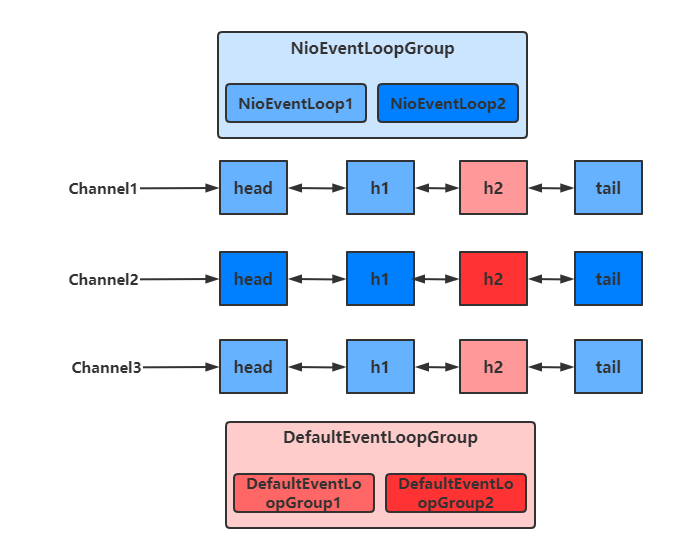
server
public static void main(String[] args) throws InterruptedException {

    EventLoopGroup bossGroup = new NioEventLoopGroup();
    EventLoopGroup workerGroup = new NioEventLoopGroup();  //cpu核心数*2
    //创建独立的group处理
    DefaultEventLoopGroup defaultEventLoopGroup = new DefaultEventLoopGroup();

    //是服务端的一个启动辅助类,通过给他设置一系列参数来绑定端口启动服务
    ServerBootstrap serverBootstrap = new ServerBootstrap();
    serverBootstrap.group(bossGroup, workerGroup)
            //设置使用NioServerSocketChannel作为服务器通道的实现
            .channel(NioServerSocketChannel.class)
            .option(ChannelOption.SO_BACKLOG, 128) //设置线程队列中等待连接的个数
            .childOption(ChannelOption.SO_KEEPALIVE, true)//保持活动连接状态
            .childHandler(new ChannelInitializer<NioSocketChannel>() {
                @Override
                protected void initChannel(NioSocketChannel nioSocketChannel) throws Exception {
                    ChannelPipeline pipeline = nioSocketChannel.pipeline();
                    pipeline.addLast(new ChannelInboundHandlerAdapter(){
                        @Override
                        public void channelRead(ChannelHandlerContext ctx, Object msg) throws Exception {
                            ByteBuf buf = (ByteBuf) msg;
                            System.out.println(Thread.currentThread().getName()+buf.toString(StandardCharsets.UTF_8));
                            ctx.fireChannelRead(msg);
                        }
                    });
                  //指定不同的group
                    pipeline.addLast(defaultEventLoopGroup,new ChannelInboundHandlerAdapter(){
                        @Override
                        public void channelRead(ChannelHandlerContext ctx, Object msg) throws Exception {
                            ByteBuf buf = (ByteBuf) msg;
                       System.out.println(Thread.currentThread().getName()+buf.toString(StandardCharsets.UTF_8));
                        }
                    });
                }
            });

    ChannelFuture future = serverBootstrap.bind(9090).sync();
    future.channel().closeFuture().sync();

		defaultEventLoopGroup.shutdownGracefully();
    bossGroup.shutdownGracefully();
    workerGroup.shutdownGracefully();
}
切换group实现原理
io.netty.channel.AbstractChannelHandlerContext#invokeChannelRead()
static void invokeChannelRead(final AbstractChannelHandlerContext next, Object msg) {
    final Object m = next.pipeline.touch(ObjectUtil.checkNotNull(msg, "msg"), next);
    //下一个handler的eventloop
    EventExecutor executor = next.executor();
    //当前handler和下一个handler是否在同一个eventloop
    if (executor.inEventLoop()) {
        //直接调用
        next.invokeChannelRead(m);
    } else {
        //交给下一个eventloop
        executor.execute(new Runnable() {
            @Override
            public void run() {
                next.invokeChannelRead(m);
            }
        });
    }
}
Channel
连接到网络套接字或能够进行读、写、连接和绑定等I/O操作的组件。
提供的功能
- 通道的当前状态(例如,它是打开的吗?它是连接吗?)
- 通道的配置参数(例如接收缓冲区大小)
- 通道支持的I/O操作(例如读、写、连接和绑定)
- ChannelPipeline处理与通道相关的所有I/O事件和请求
所有的I/O操作都是异步的
- 这意味着任何I/O调用将立即返回,而不保证请求的I/O操作在调用结束时已经完成。
- 相反,会返回一个ChannelFuture实例,该实例将在请求的I/O操作成功、失败或取消时通知。
有继承关系
- 比如 一个被ServerSocketChannel接受的SocketChannel,将在parent()上返回ServerSocketChannel作为SocketChannel的parent。
释放资源
- 调用close()或close(ChannelPromise)来释放所有资源,一旦你完成了Channel。这确保了所有资源都以适当的方式释放
		//返回全局唯一id
    ChannelId id();
    //返回组册的EventLoop
    EventLoop eventLoop();
    //返回parent或null
    Channel parent();
    //返回config
    ChannelConfig config();
    //判断是否open(active之后)
    boolean isOpen();
    //判断是否注册到EventLoop
    boolean isRegistered();
    //判断是否连接建立完成
    boolean isActive();

    ChannelMetadata metadata();
    //获取localAddresss或null
    SocketAddress localAddress();
		//返回remoteAddress或null
    SocketAddress remoteAddress();
    //获取closeFuture
    ChannelFuture closeFuture();
    //判断是否可写
    boolean isWritable();
    //如果可写,获取最多可以写多少字节,直到isWriteable返回false
    long bytesBeforeUnwritable();
    //获取至少缓存区还要刷出的字节数才可写
    long bytesBeforeWritable();

  	//localAddress()
		//remoteAddress()
		//closeForcibly()
		//register(EventLoop, ChannelPromise)
		//deregister(ChannelPromise)
		//voidPromise()
    Unsafe unsafe();
		//获取pipeline
    ChannelPipeline pipeline();
    //获取ByteBufAllocator
    ByteBufAllocator alloc();
    @Override
    Channel read();
    @Override
    Channel flush();

//继承ChannelOutboundInvoker借口
//连接,断开连接,注册,绑定,读写数据等等

//继承AttributeMap
//线程安全的Map

//继承Comparable
EmbeddedChannel
EmbeddedChannel可以用于测试各个handler,通过其构造函数按顺序传入需要测试handler,然后调用对应的Inbound和Outbound方法即可
public class TestEmbeddedChannel {
    public static void main(String[] args) {
        ChannelInboundHandlerAdapter h1 = new ChannelInboundHandlerAdapter() {
            @Override
            public void channelRead(ChannelHandlerContext ctx, Object msg) throws Exception {
                System.out.println("1");
                super.channelRead(ctx, msg);
            }
        };

        ChannelInboundHandlerAdapter h2 = new ChannelInboundHandlerAdapter() {
            @Override
            public void channelRead(ChannelHandlerContext ctx, Object msg) throws Exception {
                System.out.println("2");
                super.channelRead(ctx, msg);
            }
        };

        ChannelOutboundHandlerAdapter h3 = new ChannelOutboundHandlerAdapter() {
            @Override
            public void write(ChannelHandlerContext ctx, Object msg, ChannelPromise promise) throws Exception {
                System.out.println("3");
                super.write(ctx, msg, promise);
            }
        };

        ChannelOutboundHandlerAdapter h4 = new ChannelOutboundHandlerAdapter() {
            @Override
            public void write(ChannelHandlerContext ctx, Object msg, ChannelPromise promise) throws Exception {
                System.out.println("4");
                super.write(ctx, msg, promise);
            }
        };

        // 用于测试Handler的Channel
        EmbeddedChannel channel = new EmbeddedChannel(h1, h2, h3, h4);

        // 执行Inbound操作
        channel.writeInbound(ByteBufAllocator.DEFAULT.buffer().writeBytes("hello".getBytes(StandardCharsets.UTF_8)));
        // 执行Outbound操作
        channel.writeOutbound(ByteBufAllocator.DEFAULT.buffer().writeBytes("hello".getBytes(StandardCharsets.UTF_8)));
    }
}
ChannelFuture
阻塞
public class MyClient {
    public static void main(String[] args) throws IOException, InterruptedException {
        ChannelFuture channelFuture = new Bootstrap()
                .group(new NioEventLoopGroup())
                .channel(NioSocketChannel.class)
                .handler(new ChannelInitializer<SocketChannel>() {
                    @Override
                    protected void initChannel(SocketChannel socketChannel) throws Exception {
                        socketChannel.pipeline().addLast(new StringEncoder());
                    }
                })
                // 该方法为异步非阻塞方法,主线程调用后不会被阻塞,真正去执行连接操作的是NIO线程
            	// NIO线程:NioEventLoop 中的线程
                .connect(new InetSocketAddress("localhost", 8080));

        // 该方法用于等待连接真正建立
        channelFuture.sync();

      	//这里获取channel一定要sync
        //获取客户端-服务器之间的Channel对象
      	//主线程去执行
        Channel channel = channelFuture.channel();
        channel.writeAndFlush("hello world");
    }
}
回调
public class MyClient {
    public static void main(String[] args) throws IOException, InterruptedException {
        ChannelFuture channelFuture = new Bootstrap()
                .group(new NioEventLoopGroup())
                .channel(NioSocketChannel.class)
                .handler(new ChannelInitializer<SocketChannel>() {
                    @Override
                    protected void initChannel(SocketChannel socketChannel) throws Exception {
                        socketChannel.pipeline().addLast(new StringEncoder());
                    }
                })
                // 该方法为异步非阻塞方法,主线程调用后不会被阻塞,真正去执行连接操作的是NIO线程
                // NIO线程:NioEventLoop 中的线程
                .connect(new InetSocketAddress("localhost", 8080));

				// 当connect方法执行完毕后,也就是连接真正建立后
        // 会在NIO线程中调用operationComplete方法
        // 回调,所以就不用sync
        channelFuture.addListener(new ChannelFutureListener() {
            @Override
            public void operationComplete(ChannelFuture channelFuture) throws Exception {
              	//nio线程去执行
                Channel channel = channelFuture.channel();
                channel.writeAndFlush("hello world");
            }
        });
    }
}
处理关闭
public class ReadClient {
    public static void main(String[] args) throws InterruptedException {
        // 创建EventLoopGroup,使用完毕后关闭
        NioEventLoopGroup group = new NioEventLoopGroup();

        ChannelFuture channelFuture = new Bootstrap()
                .group(group)
                .channel(NioSocketChannel.class)
                .handler(new ChannelInitializer<SocketChannel>() {
                    @Override
                    protected void initChannel(SocketChannel socketChannel) throws Exception {
                        socketChannel.pipeline().addLast(new StringEncoder());
                    }
                })
                .connect(new InetSocketAddress("localhost", 8080));
        //阻塞
        channelFuture.sync();

        Channel channel = channelFuture.channel();
        Scanner scanner = new Scanner(System.in);

        // 创建一个线程用于输入并向服务器发送
        new Thread(()->{
            while (true) {
                String msg = scanner.next();
                if ("q".equals(msg)) {
                    // 关闭操作是异步的,在NIO线程中执行
                    channel.close();
                    break;
                }
                channel.writeAndFlush(msg);
            }
        }, "inputThread").start();

        // 获得closeFuture对象
        ChannelFuture closeFuture = channel.closeFuture();
        System.out.println("waiting close...");

        // 同步等待NIO线程执行完close操作
      	 //只要没有调用channel.close()主线程会一直阻塞在这里
        closeFuture.sync();

        // 关闭之后执行一些操作,可以保证执行的操作一定是在channel关闭以后执行的
        System.out.println("关闭之后执行一些额外操作...");

        // 关闭EventLoopGroup
        group.shutdownGracefully();
    }
}
closeFuture回调
closeFuture.addListener(new ChannelFutureListener() {
    @Override
    public void operationComplete(ChannelFuture channelFuture) throws Exception {
        // 等待channel关闭后才执行的操作
        System.out.println("关闭之后执行一些额外操作...");
        // 关闭EventLoopGroup
        group.shutdownGracefully();
    }
});
关系
| 功能/名称 | jdk Future | netty Future 继承自jdk Future | Promise 继承自netty Future |
|---|---|---|---|
| cancel | 取消任务 | ||
| isCanceled | 任务是否取消 | ||
| isDone | 任务是否完成,不能区分成功失败 | ||
| get | 获取任务结果,阻塞等待 | ||
| getNow | - | 获取任务结果,非阻塞,还未产生结果时返回 null | |
| await | - | 等待任务结束,如果任务失败,**不会抛异常(不是打断异常,是异步逻辑中的异常)**,而是通过 isSuccess 判断 | |
| sync | - | 等待任务结束,如果任务失败,抛出异常(reThrow异步逻辑中的异常) | |
| isSuccess | - | 判断任务是否成功 | |
| cause | - | 获取失败信息,非阻塞,如果没有失败,返回null | |
| addLinstener | - | 添加回调,异步接收结果 | |
| removeListeners | - | 删除回调 | |
| setSuccess | - | - | 设置成功结果,设置失败抛异常(DefaultPromise) |
| setFailure | - | - | 设置失败结果,设置失败抛异常(DefaultPromise) |
| trySuccess | - | - | 设置成功结果,返回是否设置成功 |
| tryFailure | - | - | 设置失败结果,返回是否设置成功 |
jdk Future
public class JdkFuture {
    public static void main(String[] args) throws ExecutionException, InterruptedException {
        ThreadFactory factory = new ThreadFactory() {
            @Override
            public Thread newThread(Runnable r) {
                return new Thread(r, "JdkFuture");
            }
        };
        // 创建线程池
        ThreadPoolExecutor executor = new ThreadPoolExecutor(5, 10,10, TimeUnit.SECONDS, new ArrayBlockingQueue<>(10), factory);

        // 获得Future对象
        Future<Integer> future = executor.submit(new Callable<Integer>() {

            @Override
            public Integer call() throws Exception {
                TimeUnit.SECONDS.sleep(1);
                return 50;
            }
        });
        // 通过阻塞的方式,获得运行结果
        System.out.println(future.get());
    }
}
Netty Future
public class NettyFuture {
    public static void main(String[] args) throws ExecutionException, InterruptedException {
        NioEventLoopGroup group = new NioEventLoopGroup();

        // 获得 EventLoop 对象
        EventLoop eventLoop = group.next();
        Future<Integer> future = eventLoop.submit(new Callable<Integer>() {
            @Override
            public Integer call() throws Exception {
                return 50;
            }
        });

        // 主线程中获取结果
        System.out.println(Thread.currentThread().getName() + " 获取结果");
        System.out.println("getNow " + future.getNow());
        System.out.println("get " + future.get());

        // NIO线程中异步获取结果
        future.addListener(new GenericFutureListener<Future<? super Integer>>() {
            @Override
            public void operationComplete(Future<? super Integer> future) throws Exception {
                System.out.println(Thread.currentThread().getName() + " 获取结果");
                System.out.println("getNow " + future.getNow());
            }
        });
    }
}
Netty Promise
public class NettyPromise {
    public static void main(String[] args) throws ExecutionException, InterruptedException {
        // 创建EventLoop
        NioEventLoopGroup group = new NioEventLoopGroup();
        EventLoop eventLoop = group.next();

        // 创建Promise对象,用于存放结果
        DefaultPromise<Integer> promise = new DefaultPromise<>(eventLoop);

        new Thread(()->{
            try {
                TimeUnit.SECONDS.sleep(1);
            } catch (InterruptedException e) {
                e.printStackTrace();
            }
            // 自定义线程向Promise中存放结果
            promise.setSuccess(50);
        }).start();

        // 主线程从Promise中获取结果
        System.out.println(Thread.currentThread().getName() + " " + promise.get());
    }
}
Handler&Pipeline
public class PipeLineServer {
    public static void main(String[] args) {
        new ServerBootstrap()
                .group(new NioEventLoopGroup())
                .channel(NioServerSocketChannel.class)
                .childHandler(new ChannelInitializer<SocketChannel>() {
                    @Override
                    protected void initChannel(SocketChannel socketChannel) throws Exception {
                        // 在socketChannel的pipeline中添加handler
                        // pipeline中handler是带有head与tail节点的双向链表,的实际结构为
    				 						// head <-> handler1 <-> ... <-> handler4 <->tail
                        // Inbound主要处理入站操作,一般为读操作,发生入站操作时会触发Inbound方法
                        // 入站时,handler是从head向后调用的
                        socketChannel.pipeline().addLast("handler1" ,new ChannelInboundHandlerAdapter() {
                            @Override
                            public void channelRead(ChannelHandlerContext ctx, Object msg) throws Exception {
                                System.out.println(Thread.currentThread().getName() + " Inbound handler 1");
                                // 父类该方法内部会调用fireChannelRead
                                // 将数据传递给下一个handler
                                super.channelRead(ctx, msg);
                            }
                        });
                        socketChannel.pipeline().addLast("handler2", new ChannelInboundHandlerAdapter() {
                            @Override
                            public void channelRead(ChannelHandlerContext ctx, Object msg) throws Exception {
                                System.out.println(Thread.currentThread().getName() + " Inbound handler 2");
                                // 执行write操作,使得Outbound的方法能够得到调用
         												socketChannel.writeAndFlush(ctx.alloc().buffer().
                                      writeBytes("Server...".getBytes(StandardCharsets.UTF_8)));
                                super.channelRead(ctx, msg);
                            }
                        });
                        // Outbound主要处理出站操作,一般为写操作,发生出站操作时会触发Outbound方法
                        // 出站时,handler的调用是从tail向前调用的
                        socketChannel.pipeline().addLast("handler3" ,new ChannelOutboundHandlerAdapter(){
                            @Override
                            public void write(ChannelHandlerContext ctx, Object msg, ChannelPromise promise) throws Exception {
                                System.out.println(Thread.currentThread().getName() + " Outbound handler 1");
                                super.write(ctx, msg, promise);
                            }
                        });
                        socketChannel.pipeline().addLast("handler4" ,new ChannelOutboundHandlerAdapter(){
                            @Override
                            public void write(ChannelHandlerContext ctx, Object msg, ChannelPromise promise) throws Exception {
                                System.out.println(Thread.currentThread().getName() + " Outbound handler 2");
                                super.write(ctx, msg, promise);
                            }
                        });
                    }
                })
                .bind(8080);
    }
}
如果给handler起了名字 ,可以调用pipeline的addAfter、addBefore等方法更灵活地向pipeline中添加handler
handler需要放入通道的pipeline中,才能根据放入顺序来使用handler
- pipeline是结构是一个带有head与tail指针的双向链表,其中的节点为handler
- 要通过ctx.fireChannelRead(msg)等方法,将当前handler的处理结果传递给下一个handler
- 当有入站(Inbound)操作时,会从head开始向后调用handler,直到handler不是处理Inbound操作为止
- 当有出站(Outbound)操作时,会从tail开始向前调用handler,直到handler不是处理Outbound操作为止
socketChannel.writeAndFlush()
当handler中调用该方法进行写操作时,会触发Outbound操作,此时是从tail向前寻找
ctx.writeAndFlush()
当handler中调用该方法进行写操作时,会触发Outbound操作,此时是从当前handler向前寻找OutboundHandler
加了@Sharable的注解的Handler是可以多线程共用的
ByteBuf
友好打印bytebuf
private static void log(ByteBuf buffer) {
    int length = buffer.readableBytes();
    int rows = length / 16 + (length % 15 == 0 ? 0 : 1) + 4;
    StringBuilder buf = new StringBuilder(rows * 80 * 2)
        .append("read index:").append(buffer.readerIndex())
        .append(" write index:").append(buffer.writerIndex())
        .append(" capacity:").append(buffer.capacity())
        .append(NEWLINE);
    appendPrettyHexDump(buf, buffer);
    System.out.println(buf.toString());
}
常用创建方式
public class ByteBufStudy {
    public static void main(String[] args) {
        // 创建ByteBuf
        ByteBuf buffer = ByteBufAllocator.DEFAULT.buffer(16);
        ByteBufUtil.log(buffer);

        // 向buffer中写入数据
        StringBuilder sb = new StringBuilder();
        for(int i = 0; i < 20; i++) {
            sb.append("a");
        }
        buffer.writeBytes(sb.toString().getBytes(StandardCharsets.UTF_8));

        // 查看写入结果
        ByteBufUtil.log(buffer);
    }
}
read index:0 write index:0 capacity:16
read index:0 write index:20 capacity:64
+-------------------------------------------------+
| 0 1 2 3 4 5 6 7 8 9 a b c d e f |
+--------+-------------------------------------------------+----------------+
|00000000| 61 61 61 61 61 61 61 61 61 61 61 61 61 61 61 61 |aaaaaaaaaaaaaaaa|
|00000010| 61 61 61 61 |aaaa |
+--------+-------------------------------------------------+----------------+ByteBuf通过ByteBufAllocator选择allocator并调用对应的buffer()方法来创建的,默认使用直接内存作为ByteBuf,容量为256个字节,可以指定初始容量的大小
当ByteBuf的容量无法容纳所有数据时,ByteBuf会进行扩容操作
如果在handler中创建ByteBuf,建议使用ChannelHandlerContext ctx.alloc().buffer()来创建
直接内存&堆内存
通过该默认方法创建的ByteBuf,使用的是基于直接内存的ByteBuf
ByteBuf buffer = ByteBufAllocator.DEFAULT.buffer(16);可以使用下面的代码来创建池化基于堆的 ByteBuf
ByteBuf buffer = ByteBufAllocator.DEFAULT.heapBuffer(16);也可以使用下面的代码来创建池化基于直接内存的 ByteBuf
ByteBuf buffer = ByteBufAllocator.DEFAULT.directBuffer(16);- 直接内存创建和销毁的代价昂贵,但读写性能高(少一次内存复制),适合配合池化功能一起用
- 直接内存对 GC 压力小,因为这部分内存不受 JVM 垃圾回收的管理,但也要注意及时主动释放
池化与非池化
池化的最大意义在于可以重用 ByteBuf,优点有
- 没有池化,则每次都得创建新的 ByteBuf 实例,这个操作对直接内存代价昂贵,就算是堆内存,也会增加 GC 压力
- 有了池化,则可以重用池中 ByteBuf 实例,并且采用了与 jemalloc 类似的内存分配算法提升分配效率
- 高并发时,池化功能更节约内存,减少内存溢出的可能
池化功能是否开启,可以通过下面的系统环境变量来设置
-Dio.netty.allocator.type={unpooled|pooled}- 4.1 以后,非 Android 平台默认启用池化实现,Android 平台启用非池化实现
- 4.1 之前,池化功能还不成熟,默认是非池化实现
bytebuf组成
最大容量与当前容量
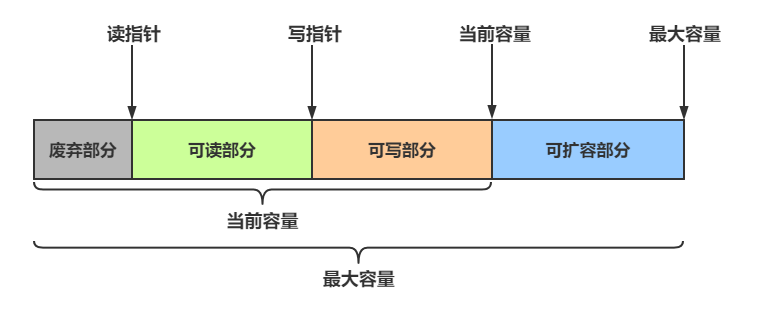
- 在构造ByteBuf时,可传入两个参数,分别代表初始容量和最大容量,若未传入第二个参数(最大容量),最大容量默认为Integer.MAX_VALUE
- 当ByteBuf容量无法容纳所有数据时,会进行扩容操作,若超出最大容量,会抛出
java.lang.IndexOutOfBoundsException异常
读写操作不同于ByteBuffer只用position进行控制,
ByteBuf分别由读指针和写指针两个指针控制
。进行读写操作时,无需进行模式的切换
- 读指针前的部分被称为废弃部分,是已经读过的内容
- 读指针与写指针之间的空间称为可读部分
- 写指针与当前容量之间的空间称为可写部分
扩容规则
- 如何写入后数据大小未超过 512 字节,则选择下一个 16 的整数倍进行扩容 例如写入后大小为 12 字节,则扩容后 capacity 是 16 字节.如果写入后数据大小超过 512 字节,则选择下一个 2n次方,例如写入后大小为 513 字节,则扩容后 capacity 是 210=1024 字节(29=512 已经不够了)
- 扩容不能超过 maxCapacity,否则会抛出
java.lang.IndexOutOfBoundsException异常
写入
常用方法如下
| 方法签名 | 含义 | 备注 |
|---|---|---|
| writeBoolean(boolean value) | 写入 boolean 值 | 用一字节 01|00 代表 true|false |
| writeByte(int value) | 写入 byte 值 | |
| writeShort(int value) | 写入 short 值 | |
| writeInt(int value) | 写入 int 值 | Big Endian(大端写入),即 0x250,写入后 00 00 02 50 |
| writeIntLE(int value) | 写入 int 值 | Little Endian(小端写入),即 0x250,写入后 50 02 00 00 |
| writeLong(long value) | 写入 long 值 | |
| writeChar(int value) | 写入 char 值 | |
| writeFloat(float value) | 写入 float 值 | |
| writeDouble(double value) | 写入 double 值 | |
| writeBytes(ByteBuf src) | 写入 netty 的 ByteBuf | |
| writeBytes(byte[] src) | 写入 byte[] | |
| writeBytes(ByteBuffer src) | 写入 nio 的 ByteBuffer | |
| int writeCharSequence(CharSequence sequence, Charset charset) | 写入字符串 | CharSequence为字符串类的父类,第二个参数为对应的字符集 |
- 网络传输中,默认习惯是 Big Endian,使用 writeInt(int value)
- 还有一类方法是 set 开头的一系列方法,也可以写入数据,但不会改变写指针位置
读取
读取主要是通过一系列read方法进行读取,读取时会根据读取数据的字节数移动读指针
如果需要重复读取,需要调用buffer.markReaderIndex()对读指针进行标记,并通过buffer.resetReaderIndex()将读指针恢复到mark标记的位置
释放
由于 Netty 中有堆外内存(直接内存)的 ByteBuf 实现,堆外内存最好是手动来释放,而不是等 GC 垃圾回收。
- UnpooledHeapByteBuf 使用的是 JVM 内存,只需等 GC 回收内存即可
- UnpooledDirectByteBuf 使用的就是直接内存了,需要特殊的方法来回收内存
- PooledByteBuf 和它的子类使用了池化机制,需要更复杂的规则来回收内存
Netty 这里采用了引用计数法来控制回收内存,每个 ByteBuf 都实现了 ReferenceCounted 接口
- 每个 ByteBuf 对象的初始计数为 1
- 调用 release 方法计数减 1,如果计数为 0,ByteBuf 内存被回收
- 调用 retain 方法计数加 1,表示调用者没用完之前,其它 handler 即使调用了 release 也不会造成回收
- 当计数为 0 时,底层内存会被回收,这时即使 ByteBuf 对象还在,其各个方法均无法正常使用
释放规则
因为 pipeline 的存在,一般需要将 ByteBuf 传递给下一个 ChannelHandler,如果在每个 ChannelHandler 中都去调用 release ,就失去了传递性(如果在这个 ChannelHandler 内这个 ByteBuf 已完成了它的使命,那么便无须再传递)
基本规则是,谁是最后使用者,谁负责 release
起点,对于 NIO 实现来讲,在 io.netty.channel.nio.AbstractNioByteChannel.NioByteUnsafe.read 方法中首次创建 ByteBuf 放入 pipeline(line 163 pipeline.fireChannelRead(byteBuf))
入站 ByteBuf 处理原则
- 对原始 ByteBuf 不做处理,调用 ctx.fireChannelRead(msg) 向后传递,这时无须 release
- 将原始 ByteBuf 转换为其它类型的 Java 对象,这时 ByteBuf 就没用了,必须 release
- 如果不调用 ctx.fireChannelRead(msg) 向后传递,那么也必须 release
- 注意各种异常,如果 ByteBuf 没有成功传递到下一个 ChannelHandler,必须 release
- 假设消息一直向后传,那么 TailContext 会负责释放未处理消息(原始的 ByteBuf)
出站 ByteBuf 处理原则
- 出站消息最终都会转为 ByteBuf 输出,一直向前传,由 HeadContext flush 后 release
异常处理原则
有时候不清楚 ByteBuf 被引用了多少次,但又必须彻底释放,可以循环调用 release 直到返回 true
while (!buffer.release()) {}
当ByteBuf被传到了pipeline的head与tail时,ByteBuf会被其中的方法彻底释放,但前提是ByteBuf被传递到了head与tail中
TailConext中释放ByteBuf的源码
protected void onUnhandledInboundMessage(Object msg) {
    try {
        logger.debug("Discarded inbound message {} that reached at the tail of the pipeline. Please check your pipeline configuration.", msg);
    } finally {
        // 具体的释放方法
        ReferenceCountUtil.release(msg);
    }
}
判断传过来的是否为ByteBuf,是的话才需要释放
public static boolean release(Object msg) {
	return msg instanceof ReferenceCounted ? ((ReferenceCounted)msg).release() : false;
}
切片
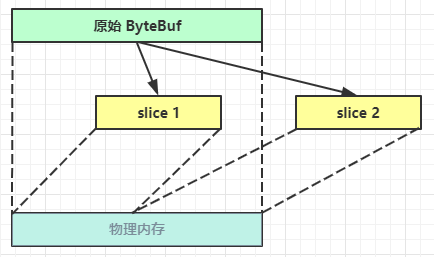
ByteBuf切片是【零拷贝】的体现之一,对原始 ByteBuf 进行切片成多个 ByteBuf,切片后的 ByteBuf 并没有发生内存复制,还是使用原始 ByteBuf 的内存,切片后的 ByteBuf 维护独立的 read,write 指针
得到分片后的buffer后,要调用其retain方法,使其内部的引用计数加一。避免原ByteBuf释放,导致切片buffer无法使用
修改原ByteBuf中的值,也会影响切片后得到的ByteBuf
public class TestSlice {
    public static void main(String[] args) {
        // 创建ByteBuf
        ByteBuf buffer = ByteBufAllocator.DEFAULT.buffer(16, 20);

        // 向buffer中写入数据
        buffer.writeBytes(new byte[]{1, 2, 3, 4, 5, 6, 7, 8, 9, 10});

        // 将buffer分成两部分
        ByteBuf slice1 = buffer.slice(0, 5);
        ByteBuf slice2 = buffer.slice(5, 5);

        // 需要让分片的buffer引用计数加一
        // 避免原Buffer释放导致分片buffer无法使用
        slice1.retain();
        slice2.retain();

        ByteBufUtil.log(slice1);
        ByteBufUtil.log(slice2);

        // 更改原始buffer中的值
        System.out.println("===========修改原buffer中的值===========");
        buffer.setByte(0,5);

        System.out.println("===========打印slice1===========");
        ByteBufUtil.log(slice1);
    }
}
运行结果
read index:0 write index:5 capacity:5
         +-------------------------------------------------+
         |  0  1  2  3  4  5  6  7  8  9  a  b  c  d  e  f |
+--------+-------------------------------------------------+----------------+
|00000000| 01 02 03 04 05                                  |.....           |
+--------+-------------------------------------------------+----------------+
read index:0 write index:5 capacity:5
         +-------------------------------------------------+
         |  0  1  2  3  4  5  6  7  8  9  a  b  c  d  e  f |
+--------+-------------------------------------------------+----------------+
|00000000| 06 07 08 09 0a                                  |.....           |
+--------+-------------------------------------------------+----------------+
===========修改原buffer中的值===========
===========打印slice1===========
read index:0 write index:5 capacity:5
         +-------------------------------------------------+
         |  0  1  2  3  4  5  6  7  8  9  a  b  c  d  e  f |
+--------+-------------------------------------------------+----------------+
|00000000| 05 02 03 04 05                                  |.....           |
+--------+-------------------------------------------------+----------------+
组合bytebuf
底层没有拷贝
addComponents第一个参数设置为true 移动写指针
ByteBuf byteBuf = ByteBufAllocator.DEFAULT.buffer().writeBytes("hello".getBytes(StandardCharsets.UTF_8));
        ByteBuf byteBuf2 = ByteBufAllocator.DEFAULT.buffer().writeBytes("hello2".getBytes(StandardCharsets.UTF_8));
        CompositeByteBuf compositeByteBuf = ByteBufAllocator.DEFAULT.compositeBuffer();
        compositeByteBuf.addComponents(true,byteBuf,byteBuf2);
read index:0 write index:11 capacity:11
+-------------------------------------------------+
| 0 1 2 3 4 5 6 7 8 9 a b c d e f |
+--------+-------------------------------------------------+----------------+
|00000000| 68 65 6c 6c 6f 68 65 6c 6c 6f 32 |hellohello2 |
+--------+-------------------------------------------------+----------------+duplicate
与原始bytebuf享用同一块内存,没拷贝,但是独立读写指针
ByteBuf byteBuf = ByteBufAllocator.DEFAULT.buffer().writeBytes("hello".getBytes(StandardCharsets.UTF_8));
ByteBuf duplicate = byteBuf.duplicate();
优势
- 池化思想 - 可以重用池中 ByteBuf 实例,更节约内存,减少内存溢出的可能
- 读写指针分离,不需要像 ByteBuffer 一样切换读写模式
- 可以自动扩容
- 支持链式调用,使用更流畅
- 很多地方体现零拷贝,例如
- slice、duplicate、CompositeByteBuf