10ConfigurationClassPostProcessor
ConfigurationClassPostProcessor
- 处理configuration的后置处理器
- 实现了BeanDefinitionRegistryPostProcessor接口
postProcessBeanDefinitionRegistry
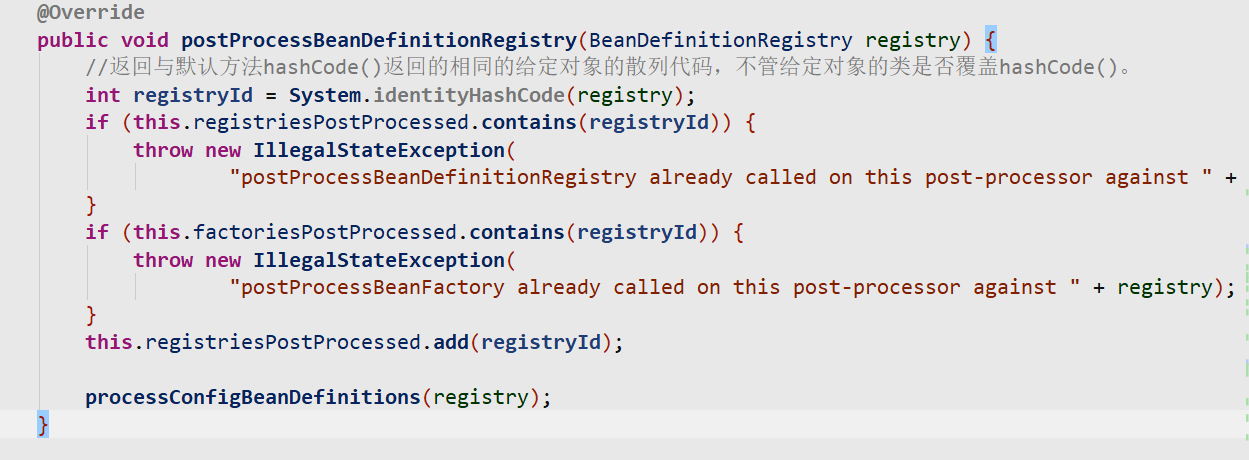
public void processConfigBeanDefinitions(BeanDefinitionRegistry registry) {
		List<BeanDefinitionHolder> configCandidates = new ArrayList<>();
		//获取到beanDefinition的名称列表
		String[] candidateNames = registry.getBeanDefinitionNames();

		for (String beanName : candidateNames) {
			//根据beanName获取beanDefinition
			BeanDefinition beanDef = registry.getBeanDefinition(beanName);
			if (beanDef.getAttribute(ConfigurationClassUtils.CONFIGURATION_CLASS_ATTRIBUTE) != null) {
				//如果属性不为空,则表示已经处理过了
				if (logger.isDebugEnabled()) {
					logger.debug("Bean definition has already been processed as a configuration class: " + beanDef);
				}
			}
			//判断有没有加Configuration,Import等注解,如果加了还要判断有没有实现Order接口,
			// 然后BeanDefinition设置Attribute,CONFIGURATION_CLASS_ATTRIBUTE
			else if (ConfigurationClassUtils.checkConfigurationClassCandidate(beanDef, this.metadataReaderFactory)) {
				configCandidates.add(new BeanDefinitionHolder(beanDef, beanName));
			}
		}

		// Return immediately if no @Configuration classes were found
		//configCandidates是所有加了注解的
		if (configCandidates.isEmpty()) {
			return;
		}

		// Sort by previously determined @Order value, if applicable
		//根据@Order排序
		configCandidates.sort((bd1, bd2) -> {
			int i1 = ConfigurationClassUtils.getOrder(bd1.getBeanDefinition());
			int i2 = ConfigurationClassUtils.getOrder(bd2.getBeanDefinition());
			return Integer.compare(i1, i2);
		});

		// Detect any custom bean name generation strategy supplied through the enclosing application context
		SingletonBeanRegistry sbr = null;
		if (registry instanceof SingletonBeanRegistry) {
			sbr = (SingletonBeanRegistry) registry;
			if (!this.localBeanNameGeneratorSet) {
				BeanNameGenerator generator = (BeanNameGenerator) sbr.getSingleton(
						AnnotationConfigUtils.CONFIGURATION_BEAN_NAME_GENERATOR);
				if (generator != null) {
					//这两个都定义了默认值,如果单例池中有,就覆盖
					this.componentScanBeanNameGenerator = generator;
					this.importBeanNameGenerator = generator;
				}
			}
		}

		if (this.environment == null) {
			this.environment = new StandardEnvironment();
		}

		// Parse each @Configuration class
		ConfigurationClassParser parser = new ConfigurationClassParser(
				this.metadataReaderFactory, this.problemReporter, this.environment,
				this.resourceLoader, this.componentScanBeanNameGenerator, registry);
		//去重
		Set<BeanDefinitionHolder> candidates = new LinkedHashSet<>(configCandidates);
		//判断是否已经处理过的
		Set<ConfigurationClass> alreadyParsed = new HashSet<>(configCandidates.size());
		do {
			// 解析配置类,在此处会解析配置类上的注解(ComponentScan扫描出的类,@Import注册的类,以及@Bean方法定义的类)
			// 注意:这一步只会将加了@Configuration注解以及通过@ComponentScan注解扫描的类才会加入到BeanDefinitionMap中
			// 通过其他注解(例如@Import、@Bean)的方式,在parse()方法这一步并不会将其解析为BeanDefinition放入到BeanDefinitionMap中,
			// 而是先解析成ConfigurationClass类
			// 真正放入到map中是在下面的this.reader.loadBeanDefinitions()方法中实现的
			parser.parse(candidates);
			parser.validate();

			Set<ConfigurationClass> configClasses = new LinkedHashSet<>(parser.getConfigurationClasses());
			configClasses.removeAll(alreadyParsed);

			// Read the model and create bean definitions based on its content
			if (this.reader == null) {
				this.reader = new ConfigurationClassBeanDefinitionReader(
						registry, this.sourceExtractor, this.resourceLoader, this.environment,
						this.importBeanNameGenerator, parser.getImportRegistry());
			}
			// 将上一步parser解析出的ConfigurationClass类加载成BeanDefinition
			// 实际上经过上一步的parse()后,解析出来的bean已经放入到BeanDefinition中了,但是由于这些bean可能会引入新的bean,
			// 例如实现了ImportBeanDefinitionRegistrar或者ImportSelector接口的bean,或者bean中存在被@Bean注解的方法
			// 因此需要执行一次loadBeanDefinition(),这样就会执行ImportBeanDefinitionRegistrar或者ImportSelector接口的方法
			// 或者@Bean注释的方法
			this.reader.loadBeanDefinitions(configClasses);
			alreadyParsed.addAll(configClasses);

			candidates.clear();
			// 这里判断registry.getBeanDefinitionCount() > candidateNames.length的目的
			// 是为了知道reader.loadBeanDefinitions(configClasses)这一步有没有向BeanDefinitionMap中添加新的BeanDefinition
			// 实际上就是看配置类(例如AppConfig类会向BeanDefinitionMap中添加bean)
			// 如果有,registry.getBeanDefinitionCount()就会大于candidateNames.length
			// 这样就需要再次遍历新加入的BeanDefinition,并判断这些bean是否已经被解析过了,如果未解析,需要重新进行解析
			// 这里的AppConfig类向容器中添加的bean,实际上在parser.parse()这一步已经全部被解析了
			if (registry.getBeanDefinitionCount() > candidateNames.length) {
				String[] newCandidateNames = registry.getBeanDefinitionNames();
				Set<String> oldCandidateNames = new HashSet<>(Arrays.asList(candidateNames));
				Set<String> alreadyParsedClasses = new HashSet<>();
				for (ConfigurationClass configurationClass : alreadyParsed) {
					alreadyParsedClasses.add(configurationClass.getMetadata().getClassName());
				}
				// 如果有未解析的类,则将其添加到candidates中,这样candidates不为空,就会进入到下一次的while的循环中
				for (String candidateName : newCandidateNames) {
					if (!oldCandidateNames.contains(candidateName)) {
						BeanDefinition bd = registry.getBeanDefinition(candidateName);
						if (ConfigurationClassUtils.checkConfigurationClassCandidate(bd, this.metadataReaderFactory) &&
								!alreadyParsedClasses.contains(bd.getBeanClassName())) {
							candidates.add(new BeanDefinitionHolder(bd, candidateName));
						}
					}
				}
				candidateNames = newCandidateNames;
			}
		}
		while (!candidates.isEmpty());

		// Register the ImportRegistry as a bean in order to support ImportAware @Configuration classes
		if (sbr != null && !sbr.containsSingleton(IMPORT_REGISTRY_BEAN_NAME)) {
			sbr.registerSingleton(IMPORT_REGISTRY_BEAN_NAME, parser.getImportRegistry());
		}

		if (this.metadataReaderFactory instanceof CachingMetadataReaderFactory) {
			// Clear cache in externally provided MetadataReaderFactory; this is a no-op
			// for a shared cache since it'll be cleared by the ApplicationContext.
			((CachingMetadataReaderFactory) this.metadataReaderFactory).clearCache();
		}
}- parse方法最终还是调用的doProcessConfigurationClass
- doProcessConfigurationClass处理了内部类
- 处理了 @PropertySource
- 处理了 @ComponentScan
- 处理了 @Import
- 会检查循环引用(stack)
- 支持BeanClassLoaderAware BeanFactoryAware EnvironmentAware ResourceLoaderAware
- ImportSelector
- DeferredImportSelector
- ImportBeanDefinitionRegistrar
- 普通import
- 处理了 @ImportResource
- @Bean
- 处理了interface defaultMethod(如果这个接口中的方法也加了@Bean注解,也需要被解析)
- 解析父类
protected final SourceClass doProcessConfigurationClass(
			ConfigurationClass configClass, SourceClass sourceClass, Predicate<String> filter)
			throws IOException {

		if (configClass.getMetadata().isAnnotated(Component.class.getName())) {
			// Recursively process any member (nested) classes first
			// 处理内部类
			processMemberClasses(configClass, sourceClass, filter);
		}

		// Process any @PropertySource annotations
		for (AnnotationAttributes propertySource : AnnotationConfigUtils.attributesForRepeatable(
				sourceClass.getMetadata(), PropertySources.class,
				org.springframework.context.annotation.PropertySource.class)) {
			if (this.environment instanceof ConfigurableEnvironment) {
				processPropertySource(propertySource);
			}
			else {
				logger.info("Ignoring @PropertySource annotation on [" + sourceClass.getMetadata().getClassName() +
						"]. Reason: Environment must implement ConfigurableEnvironment");
			}
		}

		// Process any @ComponentScan annotations
		//直接注入到bd
		Set<AnnotationAttributes> componentScans = AnnotationConfigUtils.attributesForRepeatable(
				sourceClass.getMetadata(), ComponentScans.class, ComponentScan.class);
		if (!componentScans.isEmpty() &&
				!this.conditionEvaluator.shouldSkip(sourceClass.getMetadata(), ConfigurationPhase.REGISTER_BEAN)) {
			for (AnnotationAttributes componentScan : componentScans) {
				// The config class is annotated with @ComponentScan -> perform the scan immediately
				Set<BeanDefinitionHolder> scannedBeanDefinitions =
						this.componentScanParser.parse(componentScan, sourceClass.getMetadata().getClassName());
				// Check the set of scanned definitions for any further config classes and parse recursively if needed
				for (BeanDefinitionHolder holder : scannedBeanDefinitions) {
					BeanDefinition bdCand = holder.getBeanDefinition().getOriginatingBeanDefinition();
					if (bdCand == null) {
						bdCand = holder.getBeanDefinition();
					}
					//对扫描出来的类也进行检查(递归)
					if (ConfigurationClassUtils.checkConfigurationClassCandidate(bdCand, this.metadataReaderFactory)) {
						parse(bdCand.getBeanClassName(), holder.getBeanName());
					}
				}
			}
		}

		// Process any @Import annotations
		//对Import ,ImportSelector ,DeferredImportSelector,ImportBeanDefinitionRegistrar处理
		//所谓的处理,都是加到集合中
		processImports(configClass, sourceClass, getImports(sourceClass), filter, true);

		// Process any @ImportResource annotations
		AnnotationAttributes importResource =
				AnnotationConfigUtils.attributesFor(sourceClass.getMetadata(), ImportResource.class);
		if (importResource != null) {
			String[] resources = importResource.getStringArray("locations");
			Class<? extends BeanDefinitionReader> readerClass = importResource.getClass("reader");
			for (String resource : resources) {
				String resolvedResource = this.environment.resolveRequiredPlaceholders(resource);
				configClass.addImportedResource(resolvedResource, readerClass);
			}
		}

		// Process individual @Bean methods
		//只是加入到集合中
		Set<MethodMetadata> beanMethods = retrieveBeanMethodMetadata(sourceClass);
		for (MethodMetadata methodMetadata : beanMethods) {
			configClass.addBeanMethod(new BeanMethod(methodMetadata, configClass));
		}

		// Process default methods on interfaces
		//通过processInterfaces()处理接口的默认方法,从JDK8开始,接口中的方法可以有自己的默认实现,
		// 因此,如果这个接口中的方法也加了@Bean注解,也需要被解析。
		processInterfaces(configClass, sourceClass);

		// Process superclass, if any
		//解析父类,如果被解析的配置类继承了某个类,那么配置类的父类也会被进行解析doProcessConfigurationClass()
		// (父类是JDK内置的类例外,即全类名以java开头的)。
		if (sourceClass.getMetadata().hasSuperClass()) {
			String superclass = sourceClass.getMetadata().getSuperClassName();
			if (superclass != null && !superclass.startsWith("java") &&
					!this.knownSuperclasses.containsKey(superclass)) {
				this.knownSuperclasses.put(superclass, configClass);
				// Superclass found, return its annotation metadata and recurse
				return sourceClass.getSuperClass();
			}
		}

		// No superclass -> processing is complete
		return null;
	}
postProcessBeanFactory
- 代理Configuration
- 只对加了@Configuration注解进行代理
- 对@Bean的factoryBean处理(把getObject换成getBean)
- 对@Bean的方法调用另外一个@Bean方法处理
- 添加后置处理器ImportAwareBeanPostProcessor
- 为被CGLIB增强时实现了EnhancedConfiguration接口的代理类,设置beanFactory属性
- ImportAware支持
- 首先对Configuration进行cglib代理
- 如果是不同的bean,就看是不是一个方法调用另一个方法,然后决定是直接执行方法,还是从beanfactory中拿
- 如果是factoryBean就再进行一次代理(cglib或Proxy),对getObject进行代理。
private Enhancer newEnhancer(Class<?> configSuperClass, @Nullable ClassLoader classLoader) {
		Enhancer enhancer = new Enhancer();
		//设置父类
		enhancer.setSuperclass(configSuperClass);
		//设置接口实际上就是一个BeanFactoryAware(能够注入BeanFactory)
		enhancer.setInterfaces(new Class<?>[] {EnhancedConfiguration.class});
		enhancer.setUseFactory(false);
		enhancer.setNamingPolicy(SpringNamingPolicy.INSTANCE);
		//添加字段$$beanFactory
		enhancer.setStrategy(new BeanFactoryAwareGeneratorStrategy(classLoader));
		// 添加了两个MethodInterceptor。(BeanMethodInterceptor和BeanFactoryAwareMethodInterceptor)
		// 通过这两个类的名称,可以猜出,前者是对加了@Bean注解的方法进行增强,后者是为代理对象的beanFactory属性进行增强
		// 被代理的对象,如何对方法进行增强呢?就是通过MethodInterceptor拦截器实现的
		// 类似于SpringMVC中的拦截器,每次执行请求时,都会对经过拦截器。
		// 同样,加了MethodInterceptor,那么在每次代理对象的方法时,都会先经过MethodInterceptor中的方法
		enhancer.setCallbackFilter(CALLBACK_FILTER);
		enhancer.setCallbackTypes(CALLBACK_FILTER.getCallbackTypes());
		return enhancer;
	}
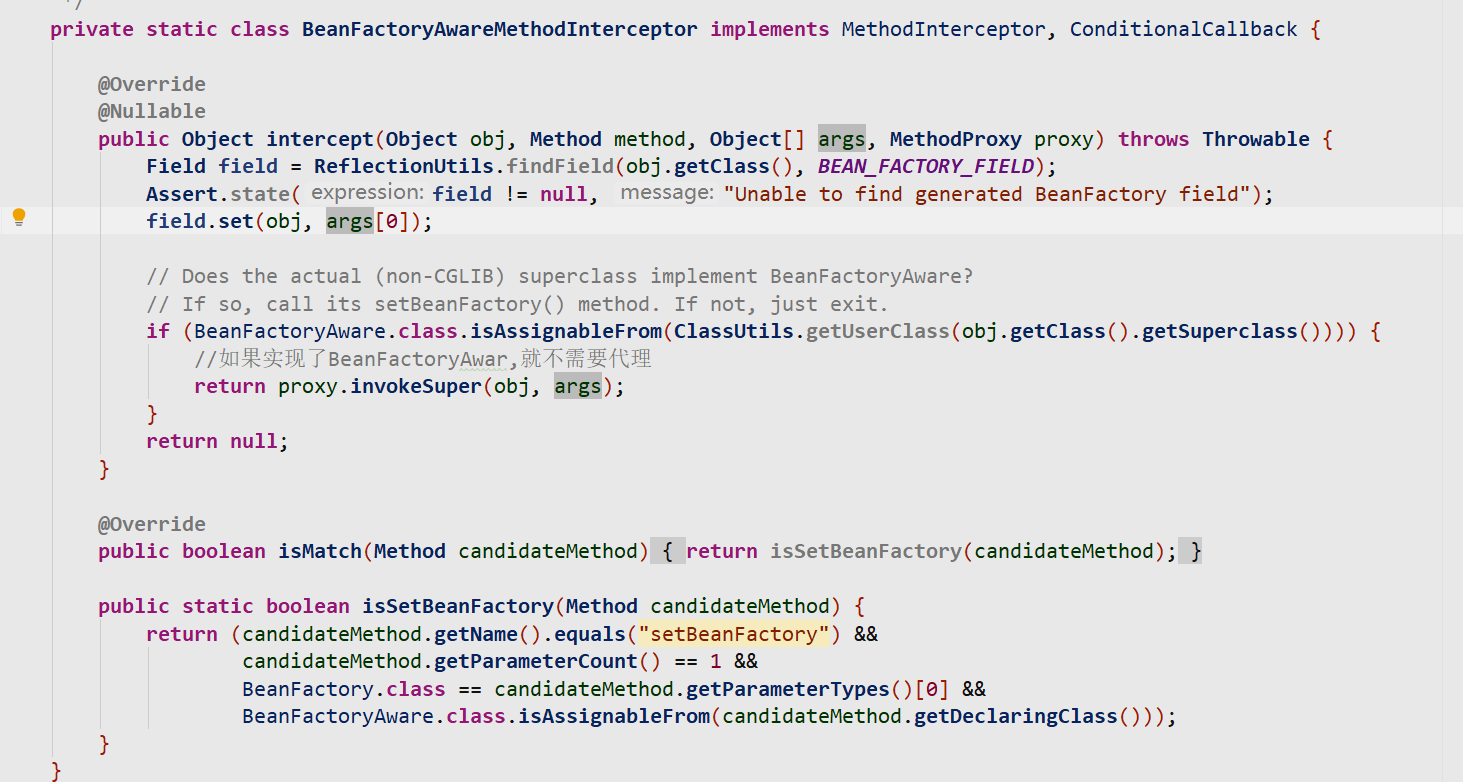
private static class BeanMethodInterceptor implements MethodInterceptor, ConditionalCallback {

		/**
		 * Enhance a {@link Bean @Bean} method to check the supplied BeanFactory for the
		 * existence of this bean object.
		 * @throws Throwable as a catch-all for any exception that may be thrown when invoking the
		 * super implementation of the proxied method i.e., the actual {@code @Bean} method
		 */
		@Override
		@Nullable
		public Object intercept(Object enhancedConfigInstance, Method beanMethod, Object[] beanMethodArgs,
					MethodProxy cglibMethodProxy) throws Throwable {

			ConfigurableBeanFactory beanFactory = getBeanFactory(enhancedConfigInstance);
			//决定存入时的beanName ,默认是方法名,也可以在@Bean注解上设置
			String beanName = BeanAnnotationHelper.determineBeanNameFor(beanMethod);

			// Determine whether this bean is a scoped-proxy
			//有没有Scope注解
			if (BeanAnnotationHelper.isScopedProxy(beanMethod)) {
				String scopedBeanName = ScopedProxyCreator.getTargetBeanName(beanName);
				if (beanFactory.isCurrentlyInCreation(scopedBeanName)) {
					beanName = scopedBeanName;
				}
			}

			// To handle the case of an inter-bean method reference, we must explicitly check the
			// container for already cached instances.

			// First, check to see if the requested bean is a FactoryBean. If so, create a subclass
			// proxy that intercepts calls to getObject() and returns any cached bean instance.
			// This ensures that the semantics of calling a FactoryBean from within @Bean methods
			// is the same as that of referring to a FactoryBean within XML. See SPR-6602.
			if (factoryContainsBean(beanFactory, BeanFactory.FACTORY_BEAN_PREFIX + beanName) &&
					factoryContainsBean(beanFactory, beanName)) {
				Object factoryBean = beanFactory.getBean(BeanFactory.FACTORY_BEAN_PREFIX + beanName);
				if (factoryBean instanceof ScopedProxyFactoryBean) {
					// Scoped proxy factory beans are a special case and should not be further proxied
				}
				else {
					// It is a candidate FactoryBean - go ahead with enhancement
					// 有两种方法,一种是Proxy,一种是cglib
					// 大概就是 beanFactory.getBean(beanName)
					return enhanceFactoryBean(factoryBean, beanMethod.getReturnType(), beanFactory, beanName);
				}
			}

			if (isCurrentlyInvokedFactoryMethod(beanMethod)) {
				// The factory is calling the bean method in order to instantiate and register the bean
				// (i.e. via a getBean() call) -> invoke the super implementation of the method to actually
				// create the bean instance.
				if (logger.isInfoEnabled() &&
						BeanFactoryPostProcessor.class.isAssignableFrom(beanMethod.getReturnType())) {
					logger.info(String.format("@Bean method %s.%s is non-static and returns an object " +
									"assignable to Spring's BeanFactoryPostProcessor interface. This will " +
									"result in a failure to process annotations such as @Autowired, " +
									"@Resource and @PostConstruct within the method's declaring " +
									"@Configuration class. Add the 'static' modifier to this method to avoid " +
									"these container lifecycle issues; see @Bean javadoc for complete details.",
							beanMethod.getDeclaringClass().getSimpleName(), beanMethod.getName()));
				}
				//自己调用自己的方法就执行自己的方法
				return cglibMethodProxy.invokeSuper(enhancedConfigInstance, beanMethodArgs);
			}
			//别人调用自己的方法,就使用引用,从factoryBean拿
			return resolveBeanReference(beanMethod, beanMethodArgs, beanFactory, beanName);
		}

		private Object resolveBeanReference(Method beanMethod, Object[] beanMethodArgs,
				ConfigurableBeanFactory beanFactory, String beanName) {

			// The user (i.e. not the factory) is requesting this bean through a call to
			// the bean method, direct or indirect. The bean may have already been marked
			// as 'in creation' in certain autowiring scenarios; if so, temporarily set
			// the in-creation status to false in order to avoid an exception.
			boolean alreadyInCreation = beanFactory.isCurrentlyInCreation(beanName);
			try {
				if (alreadyInCreation) {
					beanFactory.setCurrentlyInCreation(beanName, false);
				}
				boolean useArgs = !ObjectUtils.isEmpty(beanMethodArgs);
				if (useArgs && beanFactory.isSingleton(beanName)) {
					// Stubbed null arguments just for reference purposes,
					// expecting them to be autowired for regular singleton references?
					// A safe assumption since @Bean singleton arguments cannot be optional...
					for (Object arg : beanMethodArgs) {
						if (arg == null) {
							useArgs = false;
							break;
						}
					}
				}
				Object beanInstance = (useArgs ? beanFactory.getBean(beanName, beanMethodArgs) :
						beanFactory.getBean(beanName));
				if (!ClassUtils.isAssignableValue(beanMethod.getReturnType(), beanInstance)) {
					// Detect package-protected NullBean instance through equals(null) check
					if (beanInstance.equals(null)) {
						if (logger.isDebugEnabled()) {
							logger.debug(String.format("@Bean method %s.%s called as bean reference " +
									"for type [%s] returned null bean; resolving to null value.",
									beanMethod.getDeclaringClass().getSimpleName(), beanMethod.getName(),
									beanMethod.getReturnType().getName()));
						}
						beanInstance = null;
					}
					else {
						String msg = String.format("@Bean method %s.%s called as bean reference " +
								"for type [%s] but overridden by non-compatible bean instance of type [%s].",
								beanMethod.getDeclaringClass().getSimpleName(), beanMethod.getName(),
								beanMethod.getReturnType().getName(), beanInstance.getClass().getName());
						try {
							BeanDefinition beanDefinition = beanFactory.getMergedBeanDefinition(beanName);
							msg += " Overriding bean of same name declared in: " + beanDefinition.getResourceDescription();
						}
						catch (NoSuchBeanDefinitionException ex) {
							// Ignore - simply no detailed message then.
						}
						throw new IllegalStateException(msg);
					}
				}
				Method currentlyInvoked = SimpleInstantiationStrategy.getCurrentlyInvokedFactoryMethod();
				if (currentlyInvoked != null) {
					String outerBeanName = BeanAnnotationHelper.determineBeanNameFor(currentlyInvoked);
					beanFactory.registerDependentBean(beanName, outerBeanName);
				}
				return beanInstance;
			}
			finally {
				if (alreadyInCreation) {
					beanFactory.setCurrentlyInCreation(beanName, true);
				}
			}
		}

		@Override
		public boolean isMatch(Method candidateMethod) {
			//拦截加了@Bean,并且有beanfactory属性
			return (candidateMethod.getDeclaringClass() != Object.class &&
					!BeanFactoryAwareMethodInterceptor.isSetBeanFactory(candidateMethod) &&
					BeanAnnotationHelper.isBeanAnnotated(candidateMethod));
		}

		private ConfigurableBeanFactory getBeanFactory(Object enhancedConfigInstance) {
			Field field = ReflectionUtils.findField(enhancedConfigInstance.getClass(), BEAN_FACTORY_FIELD);
			Assert.state(field != null, "Unable to find generated bean factory field");
			Object beanFactory = ReflectionUtils.getField(field, enhancedConfigInstance);
			Assert.state(beanFactory != null, "BeanFactory has not been injected into @Configuration class");
			Assert.state(beanFactory instanceof ConfigurableBeanFactory,
					"Injected BeanFactory is not a ConfigurableBeanFactory");
			return (ConfigurableBeanFactory) beanFactory;
		}

		/**
		 * Check the BeanFactory to see whether the bean named <var>beanName</var> already
		 * exists. Accounts for the fact that the requested bean may be "in creation", i.e.:
		 * we're in the middle of servicing the initial request for this bean. From an enhanced
		 * factory method's perspective, this means that the bean does not actually yet exist,
		 * and that it is now our job to create it for the first time by executing the logic
		 * in the corresponding factory method.
		 * <p>Said another way, this check repurposes
		 * {@link ConfigurableBeanFactory#isCurrentlyInCreation(String)} to determine whether
		 * the container is calling this method or the user is calling this method.
		 * @param beanName name of bean to check for
		 * @return whether <var>beanName</var> already exists in the factory
		 */
		private boolean factoryContainsBean(ConfigurableBeanFactory beanFactory, String beanName) {
			return (beanFactory.containsBean(beanName) && !beanFactory.isCurrentlyInCreation(beanName));
		}

		/**
		 * Check whether the given method corresponds to the container's currently invoked
		 * factory method. Compares method name and parameter types only in order to work
		 * around a potential problem with covariant return types (currently only known
		 * to happen on Groovy classes).
		 */
		private boolean isCurrentlyInvokedFactoryMethod(Method method) {
			//ThreadLocal

			Method currentlyInvoked = SimpleInstantiationStrategy.getCurrentlyInvokedFactoryMethod();
			return (currentlyInvoked != null && method.getName().equals(currentlyInvoked.getName()) &&
					Arrays.equals(method.getParameterTypes(), currentlyInvoked.getParameterTypes()));
		}

		/**
		 * Create a subclass proxy that intercepts calls to getObject(), delegating to the current BeanFactory
		 * instead of creating a new instance. These proxies are created only when calling a FactoryBean from
		 * within a Bean method, allowing for proper scoping semantics even when working against the FactoryBean
		 * instance directly. If a FactoryBean instance is fetched through the container via &-dereferencing,
		 * it will not be proxied. This too is aligned with the way XML configuration works.
		 *
		 * exposedType--》returnType
		 */
		private Object enhanceFactoryBean(final Object factoryBean, Class<?> exposedType,
				final ConfigurableBeanFactory beanFactory, final String beanName) {

			try {
				Class<?> clazz = factoryBean.getClass();
				boolean finalClass = Modifier.isFinal(clazz.getModifiers());
				boolean finalMethod = Modifier.isFinal(clazz.getMethod("getObject").getModifiers());
				if (finalClass || finalMethod) {
					if (exposedType.isInterface()) {
						if (logger.isTraceEnabled()) {
							logger.trace("Creating interface proxy for FactoryBean '" + beanName + "' of type [" +
									clazz.getName() + "] for use within another @Bean method because its " +
									(finalClass ? "implementation class" : "getObject() method") +
									" is final: Otherwise a getObject() call would not be routed to the factory.");
						}
						//使用动态代理
						return createInterfaceProxyForFactoryBean(factoryBean, exposedType, beanFactory, beanName);
					}
					else {
						if (logger.isDebugEnabled()) {
							logger.debug("Unable to proxy FactoryBean '" + beanName + "' of type [" +
									clazz.getName() + "] for use within another @Bean method because its " +
									(finalClass ? "implementation class" : "getObject() method") +
									" is final: A getObject() call will NOT be routed to the factory. " +
									"Consider declaring the return type as a FactoryBean interface.");
						}
						return factoryBean;
					}
				}
			}
			catch (NoSuchMethodException ex) {
				// No getObject() method -> shouldn't happen, but as long as nobody is trying to call it...
			}
			//cglib
			return createCglibProxyForFactoryBean(factoryBean, beanFactory, beanName);
		}

		private Object createInterfaceProxyForFactoryBean(final Object factoryBean, Class<?> interfaceType,
				final ConfigurableBeanFactory beanFactory, final String beanName) {

			return Proxy.newProxyInstance(
					factoryBean.getClass().getClassLoader(), new Class<?>[] {interfaceType},
					(proxy, method, args) -> {
						if (method.getName().equals("getObject") && args == null) {
							//从beanFactory中拿
							return beanFactory.getBean(beanName);
						}
						return ReflectionUtils.invokeMethod(method, factoryBean, args);
					});
		}

		private Object createCglibProxyForFactoryBean(final Object factoryBean,
				final ConfigurableBeanFactory beanFactory, final String beanName) {

			Enhancer enhancer = new Enhancer();
			enhancer.setSuperclass(factoryBean.getClass());
			enhancer.setNamingPolicy(SpringNamingPolicy.INSTANCE);
			enhancer.setCallbackType(MethodInterceptor.class);

			// Ideally create enhanced FactoryBean proxy without constructor side effects,
			// analogous to AOP proxy creation in ObjenesisCglibAopProxy...
			Class<?> fbClass = enhancer.createClass();
			Object fbProxy = null;

			if (objenesis.isWorthTrying()) {
				try {
					fbProxy = objenesis.newInstance(fbClass, enhancer.getUseCache());
				}
				catch (ObjenesisException ex) {
					logger.debug("Unable to instantiate enhanced FactoryBean using Objenesis, " +
							"falling back to regular construction", ex);
				}
			}

			if (fbProxy == null) {
				try {
					fbProxy = ReflectionUtils.accessibleConstructor(fbClass).newInstance();
				}
				catch (Throwable ex) {
					throw new IllegalStateException("Unable to instantiate enhanced FactoryBean using Objenesis, " +
							"and regular FactoryBean instantiation via default constructor fails as well", ex);
				}
			}

			((Factory) fbProxy).setCallback(0, (MethodInterceptor) (obj, method, args, proxy) -> {
				if (method.getName().equals("getObject") && args.length == 0) {
					//最终还是getBean
					return beanFactory.getBean(beanName);
				}
				return proxy.invoke(factoryBean, args);
			});

			return fbProxy;
		}
	}
importSelector
- 实现ImportSelector 返回string数组
*高级用法例(不依赖于ComponentScan)
@Documented
@Retention(RetentionPolicy.RUNTIME)
@Target(ElementType.TYPE)
@Import(HelloImportSelector.class)
public @interface HelloServiceScan {

    @AliasFor("value")
    String[] basePackages() default {};

    @AliasFor("basePackages")
    String[] value() default {};

}

public class HelloImportSelector implements ImportSelector {

    @Override
    public String[] selectImports(AnnotationMetadata importingClassMetadata) {
        Map<String, Object> annotationAttributes = importingClassMetadata.getAnnotationAttributes(HelloServiceScan.class.getName());
        String[] basePackages = (String[]) annotationAttributes.get("basePackages");
        if (basePackages == null || basePackages.length == 0) {//HelloServiceScan的basePackages默认为空数组
            String basePackage = null;
            try {
                basePackage = Class.forName(importingClassMetadata.getClassName()).getPackage().getName();
            } catch (ClassNotFoundException e) {
                e.printStackTrace();
            }
            basePackages = new String[] {basePackage};
        }
        ClassPathScanningCandidateComponentProvider scanner = new ClassPathScanningCandidateComponentProvider(false);
        TypeFilter helloServiceFilter = new AssignableTypeFilter(HelloService.class);
        scanner.addIncludeFilter(helloServiceFilter);
        Set<String> classes = new HashSet<>();
        for (String basePackage : basePackages) {
            scanner.findCandidateComponents(basePackage).forEach(beanDefinition -> classes.add(beanDefinition.getBeanClassName()));
        }
        return classes.toArray(new String[classes.size()]);
    }

}

@Configuration
@HelloServiceScan("com.elim.spring.core.importselector")
public class HelloConfiguration {

}
@PropertySource
@Configuration
@PropertySource(value = "classpath:application.properties",ignoreResourceNotFound = false)
public class SpringPropertysourceApplication {

  @Resource
  Environment environment;

  @Bean
  public TestBean testBean(){
    TestBean testBean = new TestBean();
    // 读取application.properties中的name
    testBean.setName(environment.getProperty("com.spring.name"));
    // 读取application.properties中的age
    testBean.setAge(Integer.valueOf(environment.getProperty("com.spring.age")));
    System.out.println("testBean = " + testBean);
    return testBean;
  }

  public static void main(String[] args) {
    ApplicationContext applicationContext = new AnnotationConfigApplicationContext(SpringPropertysourceApplication.class);
    TestBean testBean = (TestBean)applicationContext.getBean("testBean");

  }
}
@Component
@PropertySource("classpath:db.properties")
public class DBConnection {
@Value("${DB_DRIVER_CLASS}")
private String driverClass;
@Value("${DB_URL}")
private String dbUrl;
@Value("${DB_USERNAME}")
private String userName;
@Value("${DB_PASSWORD}")
private String password;
public DBConnection(){}
public void printDBConfigs(){
System.out.println("Db Driver Class = " + driverClass);
System.out.println("Db url = " + dbUrl);
System.out.println("Db username = " + userName);
System.out.println("Db password = " + password);
}
}DeferredImportSelector
- 最后执行的selector,如果有多个支持排序(PriorityOrdered,Orderd)
ImportBeanDefinitionRegistrar
- 高级用法@MapperScan
10ConfigurationClassPostProcessor
https://jiajun.xyz/2020/10/10/java/spring/10ConfigurationClassPostProcessor/